Object Context:
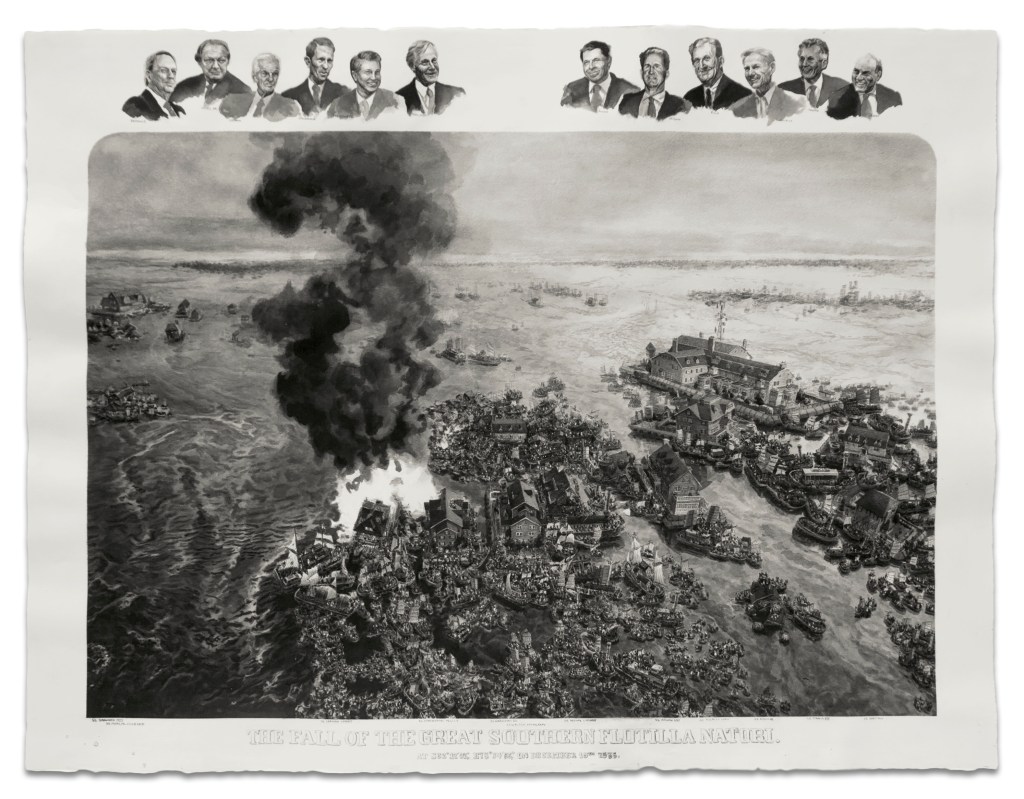
The Fall of the Great Southern Flotilla Natori
RHS Archive # 2535-12-46-1546-Cat08-78892a
Among the various flotillas established in the Southern Ocean, none could rival the affluence of the Natori. At its zenith, the influence commanded by the ‘Great Southern Flotilla’ matched the might of the Antarctic Collective (AC) and the Olde Australian Conglomerate. Natori’s renown extended beyond its wealth and vibrant marketplaces; it also stood as a loyal and unwavering ally to the Antarctic Collective.
On a fateful morning on December 19th, 2535, tragedy struck as marauding nomadic groups wreaked havoc upon Flotilla Natori, resulting in the devastating loss of thousands of lives within a few brief hours. In the aftermath, 4,802 souls were declared missing or deceased. What compounded the enormity of this violence was the unusual level of organization exhibited by these nomadic groups, which contrasted starkly with their historically unstructured nature.
News of this catastrophe sent ripples of fear throughout the Antarctic Circle. In the absence of credible information clarifying the events surrounding Natori, wild speculations filled the void. High Councilor Tyrell Welford of the Antarctic Collective, vehemently condemned the massacre, using inflammatory rhetoric that further demonized the nomads and reignited tensions with these regional maritime communities. Later that same year, when the renowned AC Ship Golden Pear mysteriously vanished, Welford pointed fingers at the same regional nomads, invoking the memory of the Natori disaster as justification. Welford’s rhetoric and efforts in the Council, along with the search for answers for the motive behind the Natori tragedy and the fate of the Pear, resulted in a policy that enabled the lawful search, seizure, and confiscation of nomad ships without cause.
In 2542 CE, clear and compelling evidence emerged on the Comoros archipelago indicating that the disappearance of the Antarctic Collective Ship (ACS) Golden Pear was a deliberate mutiny rather than an attack by Southern Ocean nomads. This discovery means the Antarctic Collective unjustly subjected the nomads and nomadic groups to the brutal Act. Recent estimates suggest that the number of nomadic casualties under the Natori-Pear Act was more than twenty times greater than the combined loss of life between the Natori and ACS Pear tragedies.
“The Gods of Prosperity”
Soon after news of the Southern Flotilla’s tragic demise reached Antarctica, High Councilor Welford’s office commissioned an artist’s rendition to honour and commemorate the lives lost in the tragedy. The image also served as a stark reminder of the potential horrors awaiting those who refused to support the Councilor’s initiatives: funding new shoreline fortifications and dispatching the defence fleet to expel all unaffiliated parties from the Southern Ocean.
The people of the Great Southern Flotilla held a unique reverence for the past icons of capitalism, elevating them to the status of deities – the Gods of Prosperity and Commerce. Their worship of these past businesspeople symbolizes the powerful connection between business and faith in the Flotilla’s culture. They adorned their houseships with the names and symbols of their favourite economic gods, believing that emulating their spirits would bring them extraordinary wealth and prosperity.
In this homage, created by the skilled artist Palermo Senatorian, the figureheads of twelve deities associated with Welford’s closest Natori salvage partners adorned the top row. The carefree demeanours and easy smiles of the deities reflect the Flotilla’s competitive and free-market values, leaving self-preservation up to the resourceful.
Rendered in transparent washes of achromatic ink on a warm page, Senatorian soberly portrays an endless, amebic flow of nomadic vessels engulfing majestic houseships, including the iconic SS Koch III. Senatorian had drawn the majestic flotilla houseships to hold a concrete presence that slowly dissolves into the chaos of the nomadic biomass. The nomads’ spectacle is shocking, total, and overwhelming, leaving viewers to ponder the cultural exchange and disparities that lead to such a horrifying outcome. The artist expressively painted the environment as if it were an ancient dream, gradually fading away under the weight of Flotilla’s opulence.
Due to a lack of details about the incident, Senatorian’s dramatic rendition of the Great Southern Flotilla Natori’s fate and the imitations that proliferated after its publication were highly persuasive in convincing most Antarcticans that the actions of the nomads were responsible for the devastation
Eteocle’s Warning
“I jolted awake to a deafening silence that made my blood run cold. I’m still reeling from what I saw outside. A sea of nomadic vessels surrounds our pier, a starved biomass slowly absorbing our home. For now, the nomads wait patiently on their decks, their gazes fixed upon our houseships—I’ve seen no signs of aggression. However, our security team remains completely unresponsive, leaving us all vulnerable to whatever may come next. Thankfully, no one has ventured to approach the Nomads yet, a small miracle. My concern deepens as the shock wears off, and I fear that [audio log section inaudible here]. I’m going out to see if I can defuse the situation before things spiral out of control.”
This log is the final entry of Ambassador Turner Eteocles, found in the wreckage of the SS Koch XII. From 2500 to his death in 2535, Mr. Eteocles was Natori’s Ambassador to the Antarctic Collective and Emissary to Regional Nomads.
In 2546, researchers from the Rothera Historical Society (RHS) conducted a study to better understand the connection between the Antarctic Nomad Pact (ANP) and the rise in violence in the Southern Ocean from 2530 to 2535. They published a paper titled “Eteocles’s Warning.” The ANP was a multinational agreement made in 2531 to stop trading and doing business with all nomadic groups, with exceptions made for influential Flotillas like Natori.
The paper resulting from this RHS study was named after Turner Eteocles, an Ambassador from the Natori Flotilla known for providing humanitarian aid and nurturing partnerships with various nomadic groups inhabiting the Southern Ocean. Eteocles strongly disagreed with the ANP, believing it was needlessly cruel and would further destabilize the Antarctic Circle. In opposition to their governments, individuals like Eteocles continued to work closely with nomads. Sadly, Turner’s concerns and warnings proved true. The ANP caused a severe shortage of food and water for nomads, pushing them to resort to raiding and piracy for survival.
One notably large group of nomads, mentioned in “Eteocles’s Warning,” resided near Île Saint-Paul and was significantly affected by the ANP’s restrictions. To save their starving children, they left their island’s safety to seek help from the Flotilla Natori, which they fondly referred to as “the home of Eteocles.” Their challenging journey brought them to the Flotilla on December 19th, 2535, as recorded in Old Australian Conglomerate shipping logs and reports.
In 2540, divers salvaged surveillance footage from the wreckage that provided further context over what transpired when the Île Saint-Paul nomads reached the Flotilla. It was evident from the recording that the nomad’s arrival was a shocking and terrifying event for the Natori citizens. The endless swarm of nomadic ships entered the Flotilla from all sides, quickly overwhelming the Flotilla’s security forces. Recovered audio suggests that many Natorians perceived the event as an invasion rather than a plea for help.
The footage revealed scenes of nomads waiting patiently on their decks for nearly two hours without anyone approaching them – it was clear that many were in extreme duress. Some nomads attempted to place their children on a nearby houseship’s deck at the two-hour mark. When Natori residents rushed to intervene, desperate nomad parents tried to thrust their children into the arms of unwilling individuals. This led to confusion, shots being fired, and a tragic outbreak of violence.
Image on loan to:
Cedar Ridge Creative Centre
Project Duration:
1 Week
Item Origin:
Antarctica, 2535 CE
 3R1C P3T1TT1